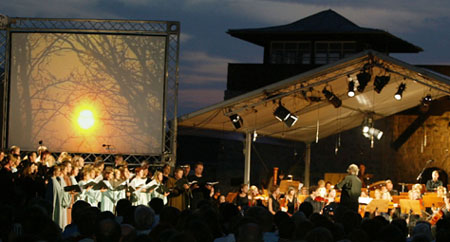
 The Oratorio originated from poems written by children living in Terezín ghetto, later set to music by Franz Waxman in the USA, who himself escaped from the Nazi Germany into the States to become one of the most significant film music composers. This performance was organized and sponsored by Austrian Cultural Forum and was one of 5 in this series.
Category Archives: News Item
Sunset Blvd. Live
On August 6, 2006, the Hollywood Bowl Orchestra made film-music history Sunday night, Aug. 6, by performing what is believed to be the first-ever live concert of a complete orchestral film score while actors read the script before an audience. The occasion at the Bowl marked the centenary of the birth of both director Billy Wilder (1906-2002) and composer Franz Waxman (1906-1967). Read more details at The Film Music Society.
TARAS BULBA – Recording Session
Watch the recording of Taras Bulba – by Franz Waxman – performed by the City of Prague Philharmonic Orchestra from January 2011.
AFI Greatest film scores
On September 23, 2005, at the Hollywood Bowl, the American Film Institute announced their list of 100 Years of Film Scores, eleven of which were by Franz Waxman: The Bride Of Frankenstein, Dr. Jekyll & Mr. Hyde, The Nun’s Story, Peyton Place, The Philadelphia Story, A Place In The Sun, Rebecca, Sayonara, The Spirit Of St. Louis, Sunset Boulevard, and Taras Bulba. Complete list at AFI.
Composer of the Week on BBC
Waxman was featured as Composer of the Week on BBC in May 2008. Listen to the complete program here.
Light & Noir at Skirball
The exhibition Light & Noir: Exiles and Émigrés in Hollywood, 1933–1950 at the Skirball Cultural Center in Los Angeles explores how the experiences of German-speaking exiles and émigrés who fled Nazi Europe influenced the classic films of Hollywood’s Golden Age through film footage, drawings, props, costumes, posters, photographs, and memorabilia. Details here. Review in the LA Times here.